

An Integrated Population Health Management Evaluation Framework
It is estimated that more than 600 ACOs exist nationwide. Providers are now taking responsibility for the health of defined populations, team-based coordination of care, and the achievement of service delivery quality and cost benchmarks. The Integrated Population Health Management Evaluation Framework will help health care organizations to effectively measure performance impact across a range of key capabilities.
WASHINGTON, DC — Patriot Labs Health, a leading provider of technology and business consulting services, announced today the release of a new population health management framework aimed at helping ACOs, health systems and hospitals evaluate a range of health IT, care coordination and performance management capabilities.
A New Tool for Evaluating Population Health Management
Healthcare reimbursement is changing, and hospitals, healthcare systems and physician groups must adapt to a new world in which providers are rewarded for meeting quality objectives for their entire patient panel –not just those actively seeking healthcare. The emphasis is clearly shifting from volume to value, and organizations that focus on providing patient-centered, quality healthcare across a population will come out ahead. The Integrated Population Health Management (PHM) Framework will help health care organizations to evaluate performance across a range of management, service delivery, operational and functional capabilities.

Integrated Population Health Management Evaluation Framework
“Population health management is fast becoming a required core competency for ACOs and other provider organizations in a post-fee service payment environment,” said Ron Garnett, executive director, Patriot Labs. “One of the things we’ve seen over the past year or two is a growing frustration among providers over the fragmented and disjointed approach to implementing health IT, care coordination, and performance management.”
Population health management is primed to play a crucial role in helping healthcare systems and physician groups achieve the Triple Aims: improve the experience of care, improve the health of populations, and lower the per-capita cost of care. While population health is only one of these aims, achieving that objective will help organizations attain the other two. Although many existing health care delivery models and frameworks focus primarily on health IT, information technology alone is not sufficient to achieve the Triple Aims. Health IT requires integrated population health management to be most effective.
“ACOs as a model to deliver high-quality, cost-effective care and improve population health management has increased significantly over the last few years,” said Jed Batchelder, practice leader, Patriot Labs Health. “As ACOs seek to balance cost control with efforts to improve outcomes and enhance patient satisfaction, they will need to have a truly integrated framework to effectively identify key priorities and evaluate ongoing performance.”
The goal of population health management is to optimize the coordination of care so patients receive the right care, provided by the right providers, in the right setting, at the right time. To accomplish this, ACOs must identify patient needs with respect to a wide range of factors influencing their health; allowing care teams to craft care plans with patients that truly reflect their needs and address the most critical drivers of patient health. The Integrated PHM Framework guides providers in understanding the capabilities needed to better manage the health of a population.
No Single HIT Framework Meets the Criteria for Effective PHM
In an effort to help organizations sort through population health, HIMSS Analytics and CCHIT have each developed frameworks aimed at defining the capabilities required for an ACO to achieve effective population health management. In addition, Dale Sanders of Health Catalyst created the popular 12-point review of population health companies outlining 12 key areas for implementing a population health management system.
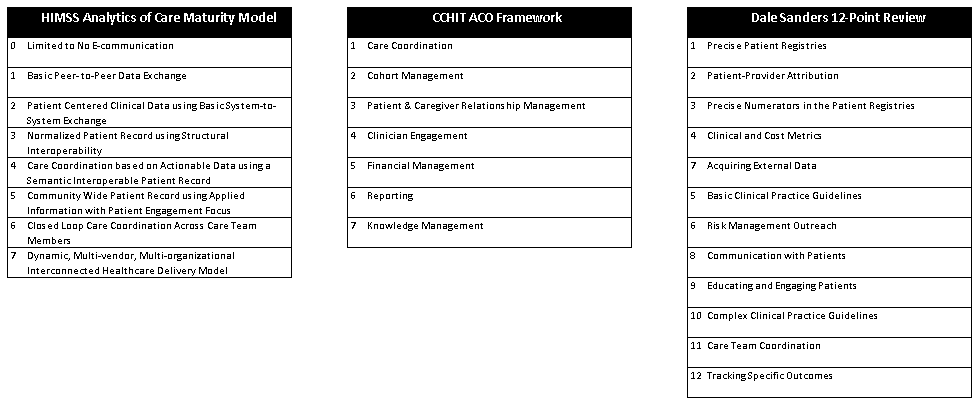
Existing HealthIT Frameworks (HIMSS Analytics, CCHIT, and Dale Sanders 12-Point Review
The original HIMSS, CCHIT and 12-Point Review models shown below remain unaltered; we have simply overlaid the three primary population health management views to each (i.e. health IT, care coordination, and performance management).
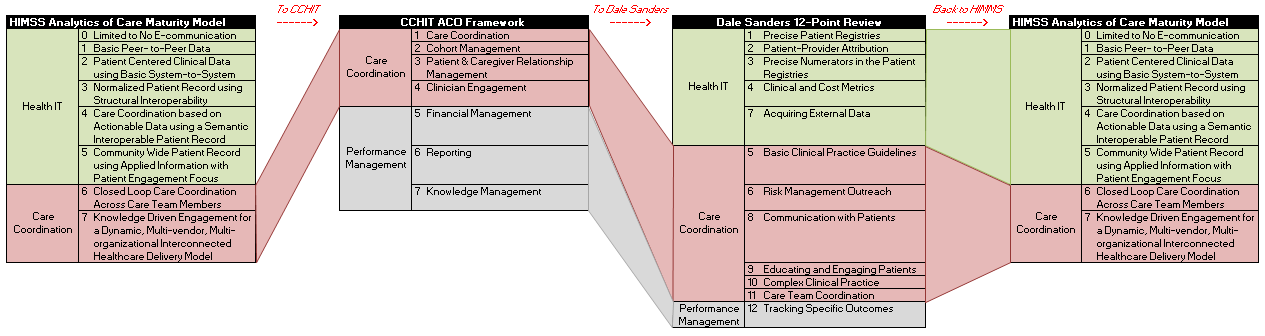
Connecting the three population health management views’ from model-to-model helps to highlight the different approaches that have been taken by each model. This is perhaps at least one reason why entities transitioning to a patient-centered population health model have struggled to translate these and similar models into a cohesive adoption strategy or comprehensive implementation roadmap. Although none of the models provide an end-to-end framework for population health, they each have key strengths: HIMSS is an excellent model for evaluating progress towards clinical data integration of patient records to support dynamic care coordination teams, CCHIT provides solid HIT adoption guidance with the recognition that the purpose of HIT is to support effective care coordination and performance management, and Dale Sanders’ 12-Point Review provides a fairly comprehensive approach to health information and systems integration.
Closing Population Health Management Gaps
While these 3 models are useful and timely, none captures the full extent of what is required for effective population health. Moreover, when the 3 models are reviewed together, the complexity of meeting all of the requirements actually becomes magnified. We have undertaken some effort to identify overlap; however, there are still likely to be overlapping focus areas that we have missed. Furthermore, each model uses slightly different terminology to describe health IT, population health and reporting and performance management requirements. The goal of the integrated framework detailed within the following sections is to create standardized definitions that simplify the evaluation of population health management capabilities.
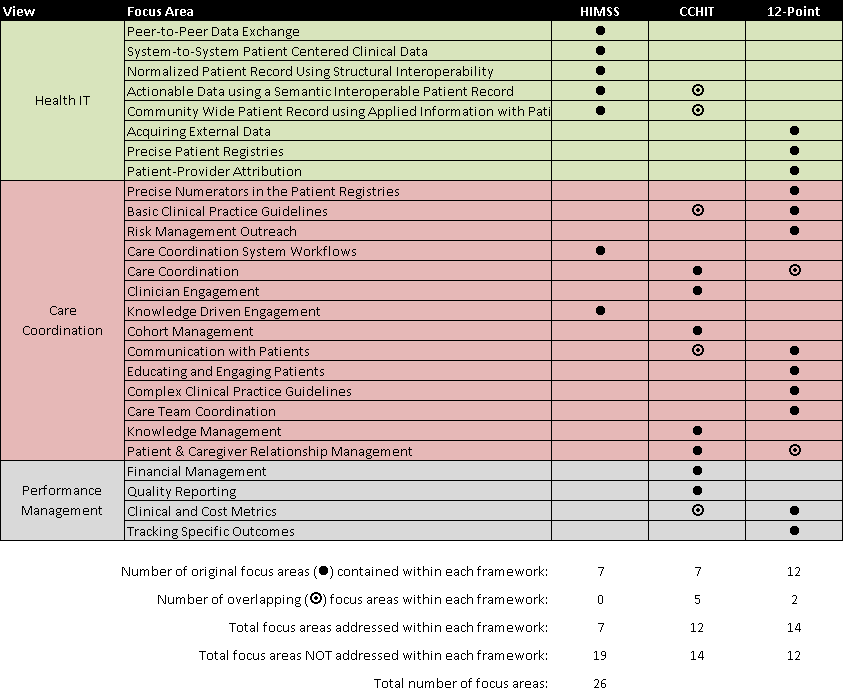
We acknowledge the valuable contributions made by these organizations. Although none of the models provide an end-to-end framework for population health, they each have key strengths: HIMSS is an excellent model for evaluating progress towards clinical data integration of patient records to support dynamic care coordination teams, CCHIT provides solid HIT adoption guidance with the recognition that the purpose of HIT is to support effective care coordination and performance management, and Dale Sanders’ 12-Point Review provides a fairly comprehensive approach to health information and systems integration.
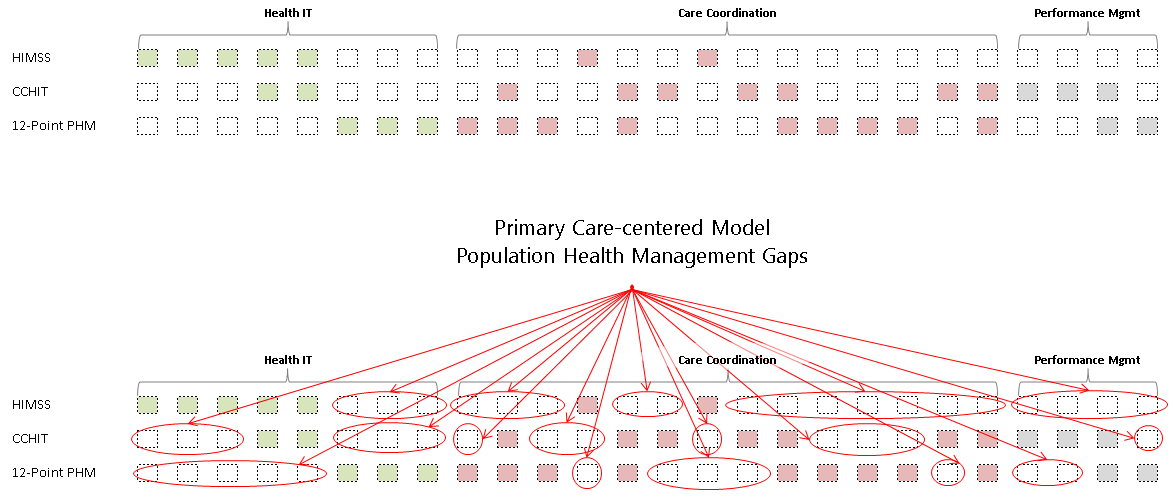
We recognize that it was not necessarily the intent of these models to address the complete range of capabilities required to support population health management across the continuum of health IT, care coordination and performance management. Some of the gaps highlighted above are the result of each framework starting from a different viewpoint (i.e. health IT vs. care coordination vs. analytics and performance management).
Integrated Population Health Management Evaluation Framework
In developing the Integrated Population Health Management (PHM) Evaluation Framework, the steps and standards contained in the original reference models have largely been left intact. They have, however, been segmented into 3 management views and 8 service delivery domains. The origin and use case for the domains are described below.

The domains summarized here are primarily sourced from the Care Continuum Alliance and their published guidebook “Implementation and Evaluation: A Population Health Guide for Primary Care Models.” The domains support primary care-centered models and provide a well-defined structure for the development and measurement of population health strategies embedded into the Integrated PHM Framework. The domains can effectively support any health care entity working towards a patient-centered population health model of care, including: integrated delivery systems, accountable care organizations, patient-centered medical homes, primary care practices, multi-specialty practices, community health collaboratives, state health exchanges, and large hospital systems.
A New Population Health Management Evaluation Tool
Patriot Labs developed the Integrated Population Health Management (PHM) Evaluation Framework to address the growing confusion among ACOs, hospitals, healthcare systems and physician groups regarding how to apply existing health IT and PHM models in a value-based health care delivery system. Rather than create yet another health IT framework, we deliberately integrated the focus areas of existing reference frameworks with which many ACOs and health care organizations are already familiar. The resulting integrated framework helps health care organizations to effectively evaluate a range of key capabilities across 27 operational focus areas.
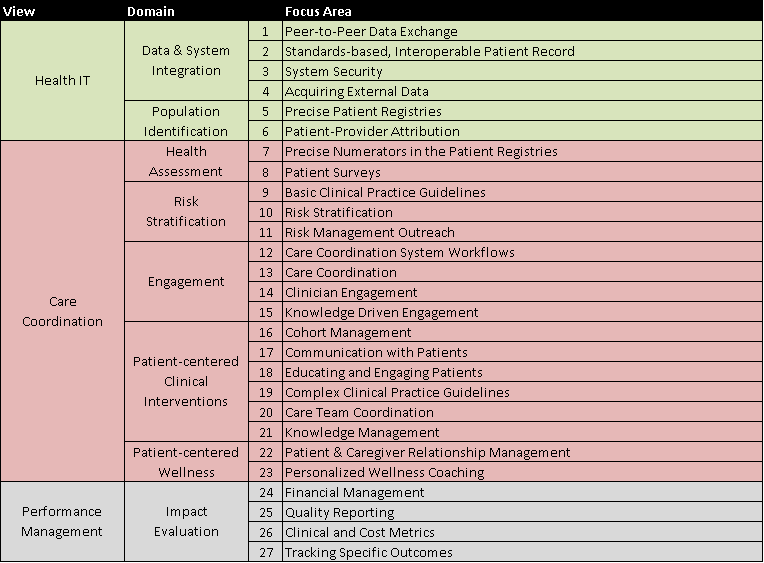
Beyond the focus areas shown here, the Integrated Population Health Management Framework incorporates 123 functional capabilities that have been translated into declarative statements aimed at helping ACOs, health systems and hospitals evaluate PHM priorities and relative performance. Soon we will releasing a benchmarking report that will enable organizations to “identify what matters” and assess relative performance. To learn more, register for one of our upcoming webinars.
Upcoming Webinar Schedule and Registration
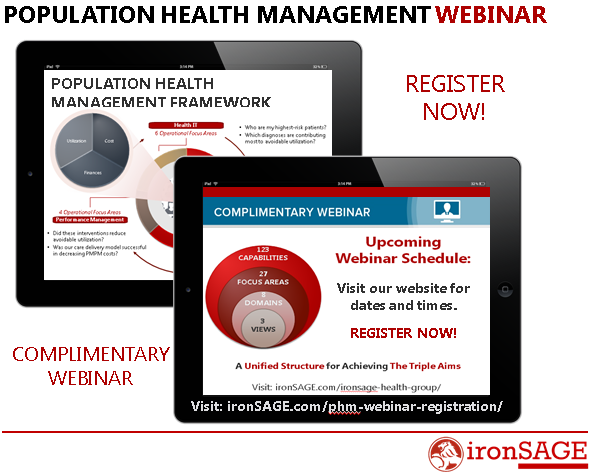
Register Now!
Have questions? Contact Patriot Labs Health director, Jed Batchelder at jed@Patriot Labs.com.
To learn more about Patriot Labs Health, please visit Patriot Labs Health or follow us on Twitter: @ironSageGroup.
About Patriot Labs Health
Patriot Labs Health is a premier provider of performance improvement, health information technology, and clinical transformation solutions for hospitals, health systems, and ACOs. By partnering with clients, Patriot Labs delivers solutions that improve quality, increase revenue, reduce expenses, and enhance physician, patient, and employee satisfaction across the healthcare enterprise. Client segments include leading national and regional integrated healthcare systems, academic medical centers, community hospitals and physician practices. Learn more at Patriot Labs Health or follow us on Twitter: @ironSageGroup.
About Patriot Labs
Patriot Labs helps clients in diverse industries leverage technology, transform the enterprise, develop business intelligence, integrate complex data, improve performance, reduce costs, optimize workflows process, and stimulate growth. Our professionals employ their expertise in strategy, technology, operations and business development to provide client-tailored services and solutions that deliver sustainable and measurable results.
Patriot Labs is committed to helping both innovative solution providers and enterprise clients succeed. For large enterprises, we dramatically accelerate delivery of industry innovations, nextgen technologies and transformational business solutions. For technology providers, we accelerate business development efforts, from market vision – to solution demonstration – to large customer acquisition. We count as clients leading corporate enterprises, government agencies, research organizations, and emerging technology companies. Our technology development and deployment collaborations support a wide range of industries, including: education, energy, environment, financial services, healthcare, manufacturing, pharma, transportation, and many more. To learn more about Patriot Labs, please visit www.Patriot Labs.com or follow us on Twitter: @ironSageGroup.
Source: Patriot Labs
Patriot Labs
Media Contact:
Marlissa Hudoson
marlissa@Patriot Labs.com
or
Health Group Contact:
Jed Batchelder
jed@Patriot Labs.com
Comments